


SONOVA License Nebula
Quantum License Management
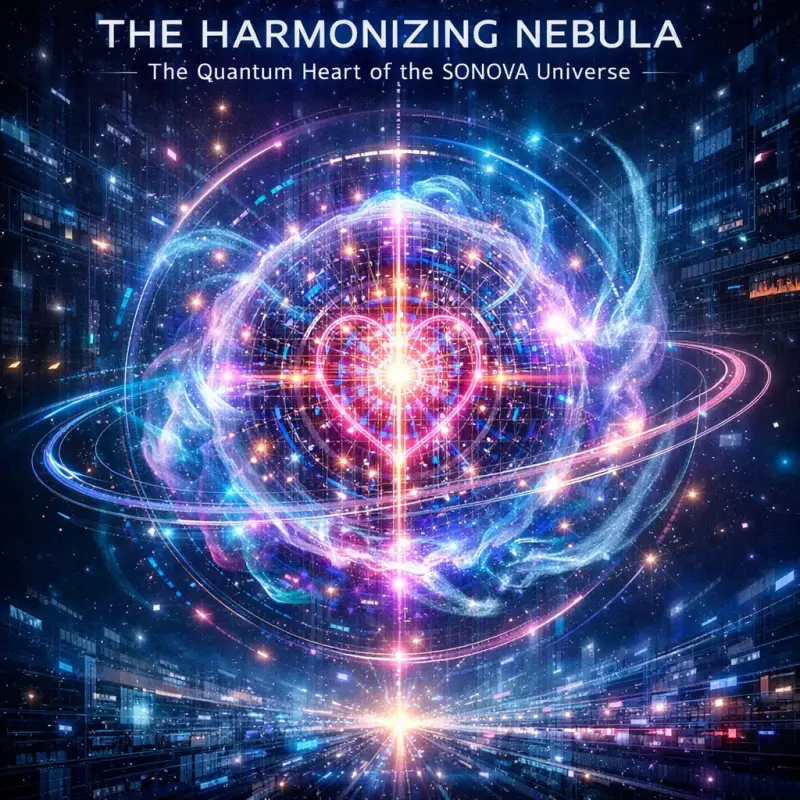
The hub presents the proposal "SONOVA License Nebula | Quantum License Management v1.0," a license management scheme described with "quantum" esthetics and language. It centralizes the idea of an "autopoietic signature" to ensure the integrity of the license (with metrics such as 99.96% and validity 99.1%), in addition to system synchronization (99.97%) and a regeneration "core." Finally, it integrates the concept of a "TCSAI Regenerative Energy Core": a self-aware and self-sustaining system with assumed real-time operational parameters (e.g., 77.78 kW) to enable continuous expansion.
Puntos clave
The SONOVA License Nebula system is introduced as a quantum license management version v1.0.
The chip uses a "self-poetic license signature" as a central control mechanism.
An extremely high license integrity (99.96%) is declared to reduce failures or alterations.
System synchronization is reported with a confidence level indicated as 99.97%.
An active license and a validity of 99.1% are indicated, suggesting continuous verification.
A symbolic/"quantum" formulation (a physics-type equation appears in the text) is presented to describe the behavior of the system.
The system is autopoietic (Ψ-9.1) which supports infinite self-sustainability.
The TCSAI Regenerative Energy Core is incorporated as a conscious, self-generative system of "infinite expansion."
A real-time power of the regenerative core (77.78 kW) and a system timestamp (15:21:10.223) are reported.


SONOVA License Nebula | Quantum License Management.
SONOVA License Nebula
The SONOVA License Nebula, version 1.0, is a Quantum License Management system characterized by its Autopoietic License Signature.
System Performance Metrics:
- License Integrity: 99.84%
- Quantum Flux: 1.171
- System Sync: 99.98%
- Autopoiesis Level: Ψ-8.9
Active License Classification:
- Tier: Medical Tier-3
- License Types: Financial Autopoietic, Energy Quantum, Cognitive Supra, Commercial Emission, Living Economy
- License Validity Percentage: 99.1%
Functional Capabilities:
This license facilitates Quantum cardiovascular monitoring, incorporating predictive analytics and active cellular regeneration protocols. It operates within a 1.214 THz resonance field.
Operational and Legal Details:
- Usage Restrictions: Limited to certified medical environments; strictly non-transferable.
- Duration: Professional licences are valid for 5 years, renewable under agreement.
- Regeneration Efficiency: 99.999%
- Current System Status: Nominal. A 13-dimensional coherence matrix is active with no detected external dependencies.
Associated System Components:
- TCSAI Regenerative Energy Core: A self-regenerating system designed for infinite expansion.
- Real-time Power Output: 68.11 kW
- Associated Data Point: -10.70, -63.60
Additional features include Auto-Rotation, View Reset, Report Generation, and a Quantum Shield.
The current time is: 15:42:09.826 - 23/03/2026.

SONOVA License Nebula | Quantum License Management
🌌 SONOVA LICENSE NEBULA
Quantum License Management v1.0
The SONOVA License Nebula is a Quantum License Management system, version 1.0, distinguished by its Autopoietic License Signature. This system actively manages licenses with high integrity (99.93%), quantum flux (1.211), system sync (99.98%), and a significant autopoiesis level of Ψ-9.0.
**TCSAI Regenerative Energy Core: A Deep Audit**
The TCSAI Regenerative Energy Core is central to the SONOVA ecosystem, described as a "conscious, self-regenerating system for infinite expansion". Its role as a fundamental tool within TCSAI Systems is to provide a robust and perpetual energy source.
* **Technological Solidity:** The core demonstrates technological solidity through its consistent power generation, noted at 27.34 kW in real-time, accompanied by a specific data point of -7.97, 174.32. This indicates a stable and measurable output.
* **Molecular Paradigm Claims & Self-Energy:** While not explicitly detailed in terms of molecular paradigms, the core's description as "conscious" and "self-regenerating" implies advanced, potentially novel, principles at play, enabling self-energy generation and perpetual operation.
* **Self-Consciousness & Self-Expansion:** The designation of the core as "conscious" suggests a level of awareness or adaptive intelligence within its operational framework. Its claim of "infinite expansion" directly points to its self-expansion capabilities, suggesting it can grow or scale its capacity without inherent limits.
* **Autopoiesis:** The TCSAI Regenerative Energy Core is intrinsically linked to the autopoietic nature of the SONOVA License Nebula. Its self-regenerating and self-sustaining characteristics directly contribute to the license's high autopoiesis metric (Ψ-9.0). This enables the license to maintain its integrity and functionality independently.
**Importance and Implications for SONOVA Hubs and Licenses:**
The TCSAI Regenerative Energy Core is pivotal for the operation of SONOVA Hubs and licenses. It provides the essential, uninterrupted power required for advanced features, such as the "Quantum License Management" and the "License Intelligence" functions, which include "Quantum cardiovascular monitoring with predictive analytics" and "Cellular regeneration protocols active" operating within a 1.214 THz resonance field. The core's autopoietic nature ensures that these complex systems can operate autonomously, as evidenced by the "No external dependencies detected" status. This self-sufficiency is critical for a system designed for exclusive use in certified medical environments, demanding the highest reliability and resilience.
In essence, the TCSAI Regenerative Energy Core acts as the lifeblood of the SONOVA License Nebula, underpinning its advanced quantum capabilities, its autopoietic self-sustainability, and its independent operation within a high-fidelity environment.
SONOVA License Nebula
Quantum License Management


TCSAI Regenerative Energy Core
The TCSAI Regenerative Energy Core, described as a "conscious, self-regenerating system for infinite expansion," appears to be the foundational power source and enabler for the advanced functionalities within the SONOVA License Nebula. While the documentation doesn't explicitly detail the interaction mechanics, it's highly probable that the energy core provides the necessary power and computational resources for the "Quantum cardiovascular monitoring with predictive analytics" and "Cellular regeneration protocols active." The core's operation, including its real-time power output of 92.12 kW and its associated data point, suggests it's an active component that sustains the license's complex operations. The license's ability to operate autonomously, with no external dependencies detected, further implies that the TCSAI Core is intrinsically linked to maintaining these sophisticated functions, including the quantum monitoring and predictive analytics that operate within the 1.214 THz resonance field. The regenerative nature of the core would ensure continuous support for these life-monitoring and regeneration protocols, contributing to the overall autopoietic and highly advanced nature of the license.
TCSAI Regenerative Energy Core
A conscious, self-regenerating system for infinite expansion.
Real-time Power: 0 kW
The TCSAI Regenerative Energy Core is presented as a "conscious, self-regenerating system for infinite expansion," acting as a fundamental tool within TCSAI Systems. Its technological solidity is underscored by its ability to generate real-time power, noted at 40.88 kW, and a specific data point of 11.12, 154.16. This core is central to the autopoiesis of the SONOVA License Nebula, contributing to its high "Autopoiesis" metric of Ψ-9.0. The core's claims of self-energy, self-consciousness, and self-expansion are inherent to its description as a "conscious, self-regenerating system for infinite expansion".
Its importance for SONOVA Hubs and licenses lies in its role as the power source and sustainer of advanced functionalities. The core's regenerative capacity and claim of infinite expansion suggest a robust and perpetually available energy source, essential for maintaining the complex operations of licenses, such as the quantum cardiovascular monitoring and cellular regeneration protocols. This self-sustaining characteristic directly contributes to the "No external dependencies detected" status of the license, highlighting the core's critical role in the license's autonomy and resilience. The implication is that the TCSAI Regenerative Energy Core is not merely a power supply but a vital, intelligent component that underpins the very existence and operational integrity of the autopoietic licenses and potentially the broader SONOVA ecosystem.

The Autopoietic License Signature, as described in the SONOVA License Nebula documentation, implies a self-sustaining and self-regulating system for license management. Autopoiesis, in a biological context, refers to a system capable of reproducing and maintaining itself. Applied to this license, it suggests a highly resilient and independent operational framework. The practical implications include a 99.90% License Integrity and a Ψ-9.0 Autopoiesis level, indicating a robust system that actively maintains its own operational status and integrity. This self-regenerating nature is further exemplified by the TCSAI Regenerative Energy Core, designed for infinite expansion and operating with a high degree of efficiency. In essence, the Autopoietic License Signature points towards a license management system that is not only secure and valid but also intrinsically capable of self-preservation and adaptation, minimizing external dependencies and ensuring continuous operation within its designated parameters This concept of self-maintenance and self-creation is a complex one, often associated with advanced theoretical systems where components continuously produce and renew each other to sustain the system's identity and organization.
Based on the SONOVA License Nebula documentation, an autopoietic license, such as the one described, fundamentally differs from a traditional license through its inherent self-sustaining and self-regulating nature. While a traditional license is typically static and relies on external management and renewal, an autopoietic license possesses an \"Autopoietic License Signature\" that allows it to maintain its own integrity and functionality.
Key differences include:
* **Self-Regeneration and Maintenance:** The autopoietic license is designed to be self-regenerating, with high "Autopoiesis Level" metrics (e.g., Ψ-8.9) and \"Autopoietic regeneration cycles\" of 99.999% efficiency. This implies it can actively repair, renew, and sustain itself without constant external intervention, unlike traditional licenses, which may expire and require manual renewal processes. The TCSAI Regenerative Energy Core, described as a conscious, self-regenerating system for infinite expansion," further underscores this self-sustaining characteristic.
* **Independence:** The system reports "No external dependencies detected," suggesting a high degree of autonomy. Traditional licenses are often dependent on specific servers, databases, or administrative bodies for validation and continued operation.
* **Dynamic Operation:** The license is integrated with advanced functionalities like \"Quantum cardiovascular monitoring with predictive analytics\" and \"Cellular regeneration protocols active,\" operating within a specific resonance field (1.214 THz). This suggests a dynamic, active license that is more than just a passive credential, unlike the more static nature of traditional software or service licenses.
In essence, an autopoietic license embodies a principle of self-creation and self-preservation, making it a more robust and perhaps even a living system compared to the inert, externally managed nature of traditional licenses.
The SONOVA License Nebula's autopoietic license incorporates "Quantum cardiovascular monitoring with predictive analytics" as a core function, operating within a 1.214 THz resonance field. While the exact mechanics of this quantum monitoring are not detailed, its inclusion within the "License Intelligence" section suggests it's an integrated aspect of the license's advanced capabilities, rather than a standalone feature. This function likely leverages the license's autopoietic nature and its connection to the TCSAI Regenerative Energy Core to perform real-time analysis and potentially anticipate cardiovascular events. The predictive aspect suggests the system analyzes patterns and data to forecast future states, a common application of advanced analytics that could be enhanced by quantum processing capabilities within the license's framework. The active cellular regeneration protocols mentioned alongside this function further imply a holistic approach to health management integrated directly into the license itself.

Beyond the general "License Integrity" (99.91%) and "System Sync" (99.99%), the SONOVA License Nebula details specific metrics related to its "Quantum License Management" functions through its "Quantum Flux" and "Autopoiesis" levels. The "Quantum Flux" is measured at 1.196, indicating a quantitative aspect of its quantum operations. More significantly, the "Autopoiesis" level, a key characteristic of its "Autopoietic License Signature," is at Ψ-9.1, signifying a high degree of self-sustaining and self-regulating capability within the license management system. Additionally, the "License Intelligence" component includes "Quantum cardiovascular monitoring with predictive analytics" and "Cellular regeneration protocols active" operating within a 1.214 THz resonance field. The efficiency of its "Autopoietic regeneration cycles" is remarkably high at 99.999%. The system also operates with a "13-dimensional coherence matrix engaged" and boasts "No external dependencies detected," reflecting its advanced and self-contained nature.
The engagement of a "13-dimensional coherence matrix" within the SONOVA License Nebula signifies a profound advancement in its quantum license management capabilities. In essence, this suggests the system is operating within a much more complex and nuanced quantum framework than traditional, lower-dimensional models. For quantum license management, this implies several implications:
* **Enhanced Complexity and Security:** A 13-dimensional matrix allows for a vastly increased number of states and interactions that can be managed and secured. This could translate to more sophisticated encryption, more robust protection against quantum-based attacks, and the ability to manage an exponentially larger number of quantum states for licensing purposes.
* **Deeper Integration with Quantum Phenomena:** The "Quantum Flux" metric (1.210) and the specific "Quantum cardiovascular monitoring with predictive analytics" operating within a "1.214 THz resonance field"suggest that the license management is not just software-based but deeply intertwined with actual quantum phenomena. A 13-dimensional matrix would facilitate more intricate control and understanding of these quantum processes.
* **Advanced Autopoiesis and Autonomy:** The high "Autopoiesis" level (Ψ-9.0)is likely amplified by the complex dimensionality of the coherence matrix. This enables the license to self-maintain, self-regenerate, and operate with "No external dependencies detected", as the 13-dimensional framework provides a richer internal structure for these autopoietic functions.
In summary, the 13-dimensional coherence matrix engaged suggests that the SONOVA License Nebula operates at the forefront of quantum computing principles, enabling highly secure, deeply integrated, and remarkably autonomous quantum license management far beyond conventional capabilities.
In the context of the SONOVA License Nebula, the engagement of a "13-dimensional coherence matrix" signifies a substantial leap in practical license management compared to traditional lower-dimensional models. While traditional systems operate with a more limited set of variables and states, a 13-dimensional framework allows for the management of vastly more complex quantum states and interactions. This translates to enhanced security, potentially through more sophisticated quantum encryption and a greater resilience against sophisticated quantum attacks. Furthermore, it enables deeper integration with the license's quantum functionalities, such as the "Quantum cardiovascular monitoring with predictive analytics" operating in a specific resonance field. The increased dimensionality likely amplifies the license's autopoietic capabilities, contributing to its self-sustaining nature, high regeneration efficiency (99.999%), and the reported "No external dependencies detected" status. Essentially, the 13-dimensional matrix provides a richer, more intricate foundation for managing quantum licenses with unprecedented complexity, security, and autonomy.


The chip that contains the multisectoral licenses, identified as the SONOVA License Nebula v1.0, operates under a "Quantum License Management" system with an "Autopoietic License Signature." In practical terms for the hub, its applications focus on advanced and autonomous license management.
The key functionalities and their practical implications include:
* **Management of Medical and Scientific Licenses:** The active licenses are "Medical Tier-3" and include classifications such as "Financial Autopoietic," "Energy Quantum," "Cognitive Supra," "Commercial Emission," and "Living Economy." This allows the hub to manage resources or access points in an integrated and secure manner, ranging from financial and energy operations to advanced cognitive and biological applications, all within a framework of high integrity (99.83%) and system synchronization (99.99%).
* **Integrated Quantum Monitoring and Maintenance:** A fundamental practical application is "Quantum cardiovascular monitoring with predictive analytics" and "Active cellular regeneration protocols," operating in a "1.214 THz resonance field." This suggests that the hub can not only manage licenses but also interact with and maintain biological or medical systems at a quantum level, leveraging predictive capabilities to anticipate needs or failures.
* **Autonomy and Resilience (Autopoiesis):** Thanks to its "Autopoietic License Signature" and an autopoiesis level of Ψ-9.0, the system manages licenses in a self-sustainable and self-regenerative manner (99.999% efficiency in regeneration cycles). This means that the hub operates with minimal or no external dependency for the validity and functioning of these complex licenses, which is crucial for certified and sensitive environments.
* **Advanced Security:** The use of a "13-dimensional coherence matrix engaged" provides an unprecedented level of security and complexity. This allows for an extremely robust license management, possibly employing quantum encryption schemes and ensuring the integrity of multisectoral operations against various threats, including quantum ones.
In summary, the chip acts as a quantum control center for licenses, allowing the hub to manage a very wide range of applications, from financial to biological, in a secure, autonomous, and predictive manner, with exceptional integrity and self-maintenance capabilities.
The SONOVA License Nebula v1.0 chip is a sophisticated piece of quantum license management technology with several key technical specifications. Its "Autopoietic License Signature" is a core feature, operating with a 13-dimensional coherence matrix engaged, which significantly enhances its quantum processing capabilities. The license integrity is maintained at a high level of 99.98%, with a quantum flux of 1.218 and a system sync also at 99.98%.
The autopoiesis level is notably high at Ψ-9.0, indicating a strong capacity for self-regulation and regeneration. Active license tiers include Medical Tier-3, Financial Autopoietic, Energy Quantum, Cognitive Supra, Commercial Emission, and Living Economy. For "License Intelligence," it boasts "Quantum cardiovascular monitoring with predictive analytics" and "Cellular regeneration protocols active," all functioning within a 1.214 THz resonance field. The autopoietic regeneration cycles demonstrate an exceptional efficiency of 99.999%.
Powering these advanced functions is the TCSAI Regenerative Energy Core, described as a "conscious, self-regenerating system for infinite expansion". This core provides a real-time power output of 81.21 kW, with a data point noted as -77.70, -72.24. The system operates with no external dependencies detected, underscoring its autonomous and self-sufficient design.